The forest has always been Sheroanawe Hakihiiwe’s point of reference. In the remote Venezuelan Amazon, where he was born and continues to live, the natural world is inseparable from the customs, beliefs, and everyday life of the Yanomami people. Over more than two decades, the artist has drawn upon that knowledge to produce an extraordinary body of work, recording everything from the intricate forms of plants and animals to the ancestral stories of his community.
On November 19, 2026, the Institute of Contemporary Art, Miami (ICA Miami) will open Hakihiiwe’s first solo museum exhibition in the United States. Organized jointly with the Fondation Cartier pour l’art contemporain, the presentation brings together more than 100 works, including drawings, paintings, prints, and new commissions. Arriving just ahead of Miami Art Week, it offers American audiences a substantial introduction to one of Venezuela’s most internationally recognized contemporary artists.
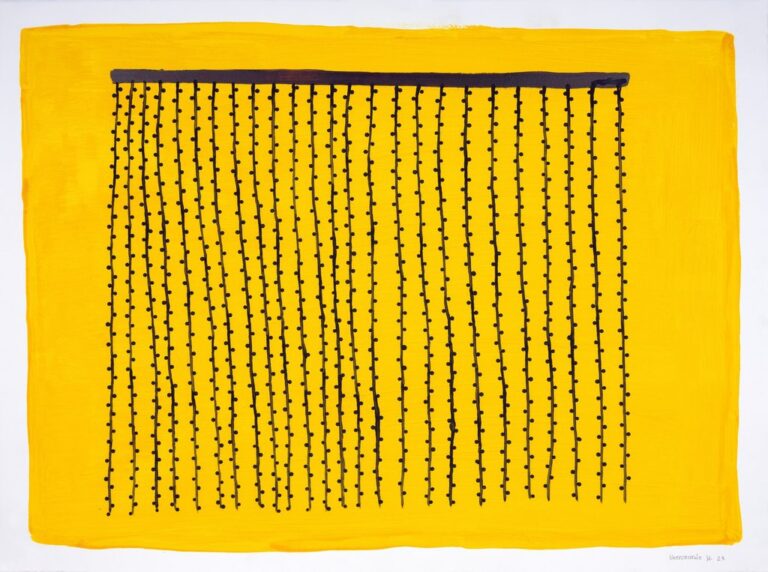
Born in 1971 in Sheroana, Hakihiiwe was raised in Poripori, a Yanomami community along the upper Orinoco River. His earliest artistic explorations developed from a close familiarity with the forest and the traditions of those who inhabit it. Working primarily on handmade paper, he began translating natural forms into delicate, often highly detailed compositions. Leaves, insects, birds, and other elements of his surroundings appear as carefully observed subjects, sometimes reduced to a few precise lines.
The apparent simplicity of these images can be deceptive. Their arrangements reflect an intimate knowledge of the environment, but also a way of understanding it that differs considerably from Western traditions of botanical illustration. For Hakihiiwe, the forest is a place of practical knowledge, ancestral memory, and spiritual meaning.
There is also a sense of urgency behind his work. Speaking at Siamo Foresta, an exhibition organized by Fondation Cartier in Milan in 2023, he expressed concern about the possible disappearance of his community, its language, and the natural environment on which its existence depends. That concern has remained an important part of his practice, although his art is far from a straightforward account of environmental loss.
Curated by Gean Moreno, Director of the Art + Research Center at ICA Miami, and Michela Alessandrini, Curator at Fondation Cartier, the exhibition follows the development of Hakihiiwe’s work through four sections.
The first, Building a Language, examines his early attempts to represent Yanomami life through drawing, including Shapono, a work referencing the communal structures traditionally inhabited by his people. Notational Systems and Encyclopedic Exercises turns to the visual classification systems he began developing in the early 2010s, when his compositions became increasingly concerned with organizing and recording the details of the natural world.
In Landscapes, the artist moves toward larger compositions and experiments with different materials. The final section, Shamanic Initiation, marks a more recent development in his work following his shamanic training. Dreams, spiritual encounters, and the relationship between visible and invisible worlds become increasingly important. New commissions include a film accompanied by the artist’s chanting, a mural created for the museum, and an installation of shamanic poles.
The exhibition has been designed by Mexican architect Mauricio Rocha and his studio, Taller de Arquitectura. Taking inspiration from the Yanomami shapono, Rocha has incorporated filtered light, natural earth pigments, and views of the surrounding landscape into the gallery design. The intention is to create an environment that recalls aspects of the artist’s cultural surroundings without attempting to reproduce the Amazon itself.
For ICA Miami, the exhibition also marks an expansion of its engagement with artistic practices that have received comparatively limited institutional exposure in the United States. Alex Gartenfeld, the museum’s Irma and Norman Braman Artistic Director, has described Hakihiiwe’s work as an expression of extensive Indigenous knowledge, noting the relevance of presenting it in a city with such strong cultural ties to Latin America.
The partnership with Fondation Cartier is particularly significant. The Paris-based institution has maintained a longstanding interest in artistic practices connected to Indigenous communities and the environment, providing an international context for Hakihiiwe’s work.
What distinguishes his practice is the way seemingly modest subjects carry layers of cultural meaning. A plant, a bird, or a pattern observed in the forest may appear almost incidental on paper. Within the Yanomami traditions that inform his work, however, such details belong to a much larger understanding of the world.
The exhibition asks visitors to look closely at those details, and to recognize how much knowledge can reside in a single line.
Sheroanawe Hakihiiwe
November 19, 2026
Institute of Contemporary Art, Miami
61 NE 41st Street, Miami, Florida
Presented jointly with the Fondation Cartier pour l’art contemporain.