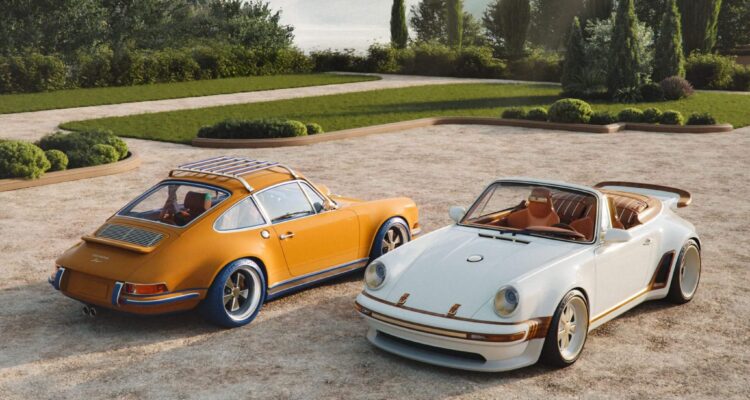
Louis Vuitton and Singer Vehicle Design unveiled two Porsche 911s developed through a collaboration that brings together automotive restoration, fashion, leather craftsmanship and watchmaking.
The automobiles, presented on August 12 during Monterey Car Week 2026, are the Porsche 911 Reimagined by Singer Classic and the Porsche 911 Reimagined by Singer Classic Turbo. The collaboration brings together Singer’s approach to design and restoring the Type 964 Porsche 911 with Louis Vuitton’s expertise in leather goods, watchmaking, trunk making, fashion and travel.
The project began with a request for a dashboard clock for a Singer reimagined Porsche 911. Louis Vuitton’s La Fabrique des Temps workshops in Switzerland developed a detachable mechanical timepiece inspired by the Tambour watch, which can also be removed from the car and used as a desk clock. The project subsequently expanded into a broader collaboration and redesign of the cars’ instruments, controls, trim and other functional elements with luggage and driving accessories.
The project began with a relatively focused request: a dashboard clock for a Singer reimagined Porsche 911. The idea expanded into a broader collaboration involving the vehicles’ interiors, instrumentation, materials, luggage and driving accessories. Louis Vuitton describes the project as its first co-branded item with Singer and the first time the House has brought its watchmaking, leather goods, trunk making, fashion and footwear expertise together within an automotive project.
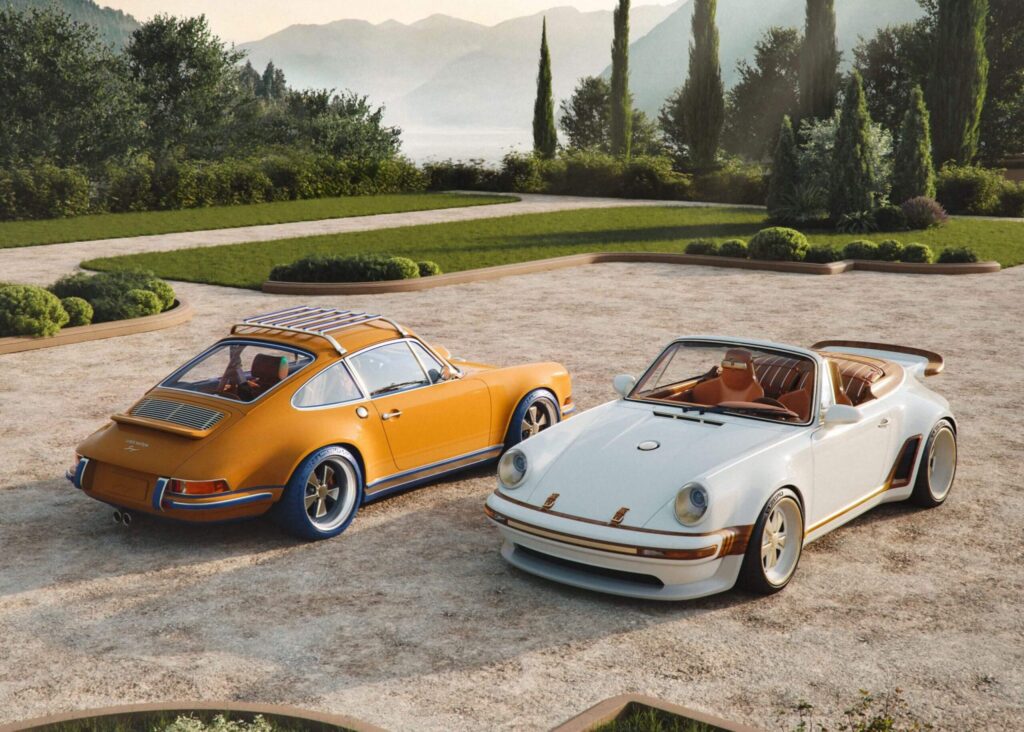
The first example revealed on August 12th at the Quail during Monterey Car Week 2026 is a Porsche 911 reimagined by Singer Classic, based on a Type 964 coupé. Its lightweight carbonfibre bodywork is finished in a combination of saffron, cobalt blue and yellow developed for Louis Vuitton.
The second is a Porsche 911 reimagined by Singer Classic Turbo, a Type 964 cabriolet developed with Nicolas Ghesquière, Artistic Director of Women’s Collections at Louis Vuitton. Its Calcaire Lutétien white bodywork combines natural leather, gold detailing and extensive woodwork with the mechanical character associated with Singer’s Turbo service.
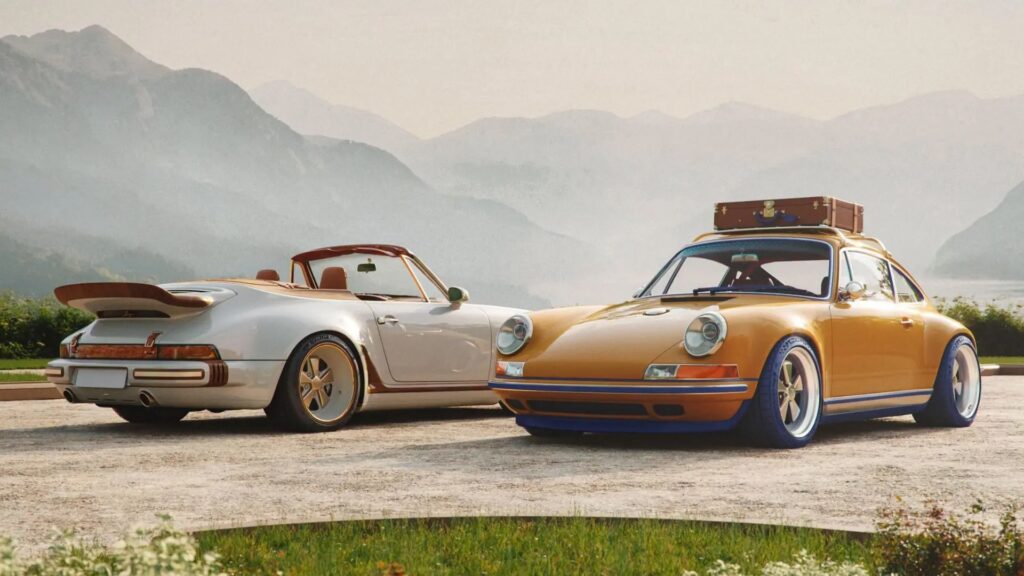
Together, the two cars represent different interpretations of the same collaboration. The Classic draws heavily from Louis Vuitton’s history of travel and automotive luggage, while the Classic Turbo takes its visual direction from Ghesquière’s interest in the relationship between automotive and nautical design.
The Tambour Clock That Started the Collaboration
The Louis Vuitton and Singer project began with a relatively focused request: a dashboard clock.
Louis Vuitton’s La Fabrique des Temps workshops in Switzerland created a detachable mechanical timepiece based on the visual language of the Tambour watch. Its distinctive case and bezel reference the design of the Tambour, including the twelve polished and engraved letters associated with the House.
The clock can be removed from the dashboard and converted for use as a desk clock, giving the component a function beyond the vehicle itself.
The initial clock project eventually led the two companies to reconsider other elements of the Porsche 911 interior. Louis Vuitton’s watchmaking expertise informed the redesign of the instruments, including the speedometer, rev counter and gauges.
The result is an instrument display that uses the graphic language of the Tambour collection while retaining the requirements of an automotive cockpit. Cobalt blue faces are accented by bright orange lettering, with the hands, indices and dial details designed as part of a unified visual system.
Jean Arnault, Louis Vuitton Watch Director, described the dashboard clock as the starting point for a much broader exploration of the House’s expertise within the automobile.
“With the creation of both cars, Louis Vuitton has, for the first time, drawn upon the full breadth of its savoir-faire, bringing together the expertise of every House métier in a unique and exclusive automotive project. Every department at Louis Vuitton has contributed to this unprecedented cross-disciplinary endeavour, from trunk makers and leather goods artisans to the fashion and footwear teams, and even the watchmakers from La Fabrique du Temps Louis Vuitton,” highlights Jean Arnault.
The Porsche 911 Reimagined by Singer Classic
The first car is a Porsche 911 developed by Singer Classic based on a Type 964 coupé.
Its lightweight carbonfibre bodywork is finished in saffron, cobalt blue and yellow. The saffron shade references colours used by Louis Vuitton for more than a century, while cobalt blue appears throughout the cabin and on the car’s demonstration tyres.
The palette also connects the automobile to Louis Vuitton’s history of travel. The House has long used saffron and related yellow tones within its packaging and products, while cobalt blue has appeared in elements of its travel goods.
The car is fitted with a specially designed roof rack capable of carrying bespoke luggage, skis or a Louis Vuitton surfboard. The arrangement recalls the House’s long history of creating trunks and accessories for automobile travel.
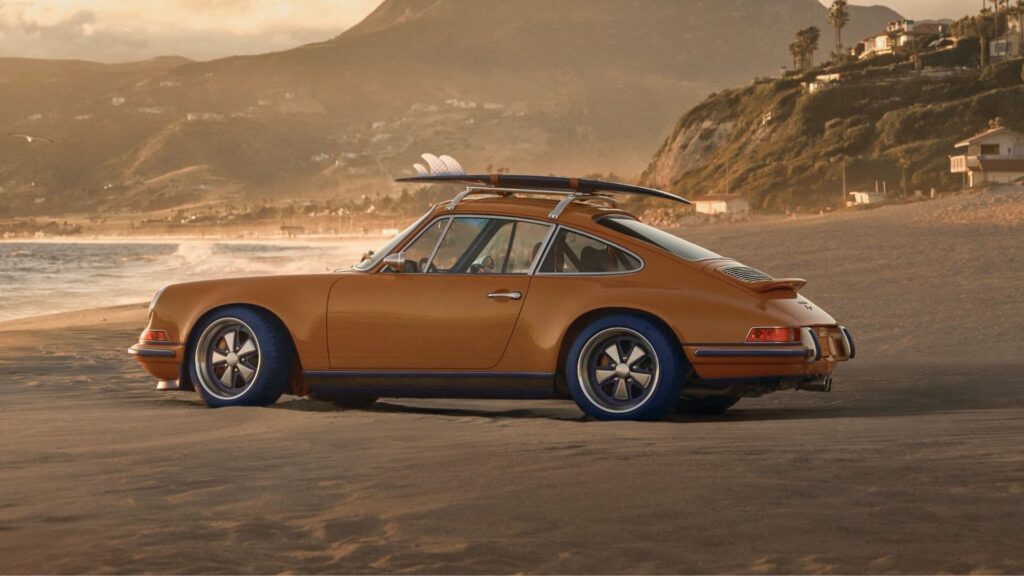
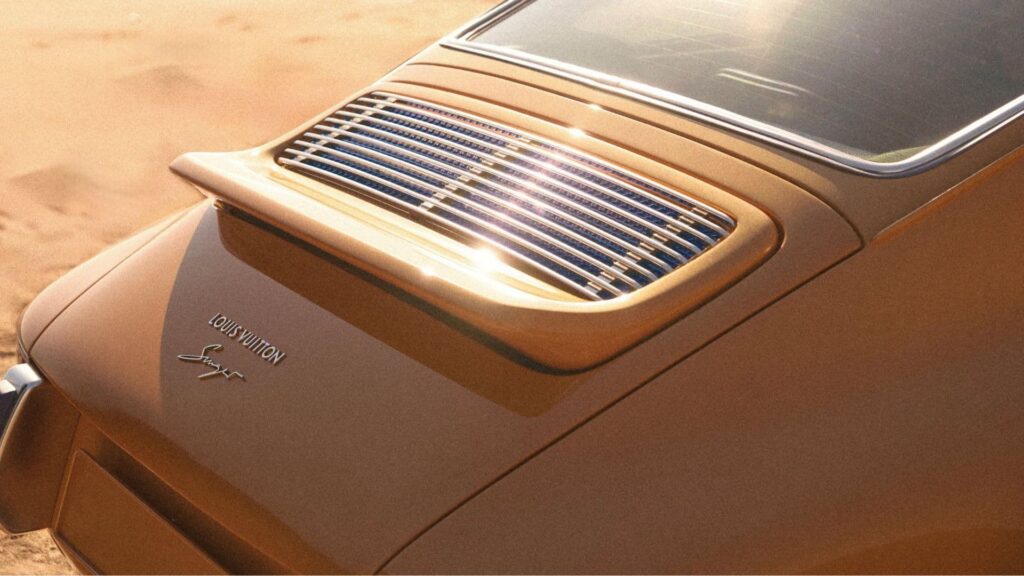
Power comes from a naturally aspirated 4.0 litre air cooled flat six driving the rear wheels through a six speed manual gearbox. Carbon ceramic brakes are fitted, while the rear wing is speed activated.
The mechanical specification maintains the analogue character associated with Singer’s reimagined Porsche 911s while giving the car a distinctive Louis Vuitton design identity.
A Porsche 911 Interior Shaped by Leather and Watchmaking
Inside, natural coloured leather inspired by Louis Vuitton’s VVT leather covers much of the cabin.
Singer carried out the leatherwork using hides selected by Louis Vuitton’s artisans. Yellow stitching and edge finishing techniques draw from methods associated with the company’s luggage and leather goods.
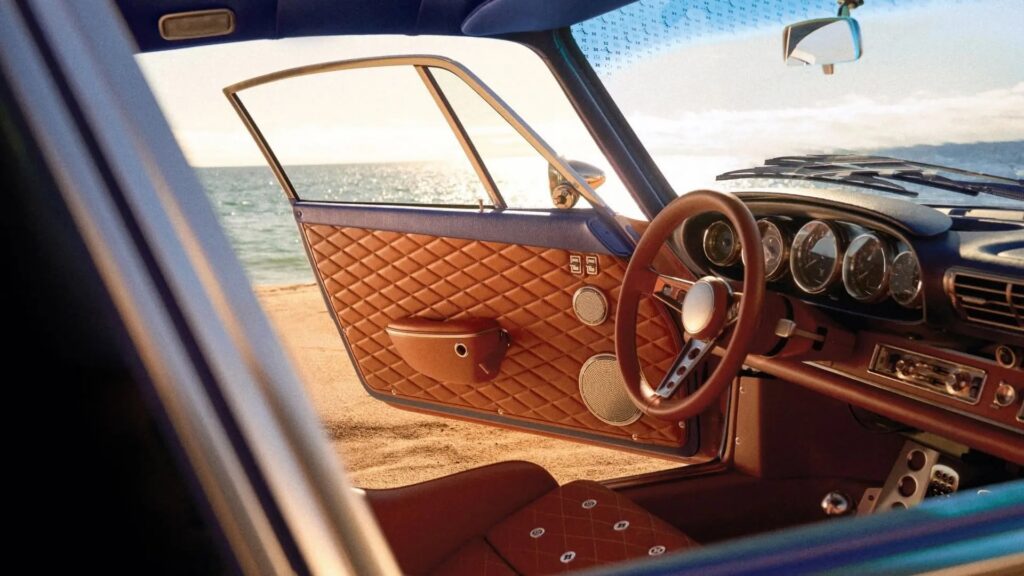
Diamond patterned embossing references the malletage used inside Louis Vuitton trunks. Ventilation holes in the seats incorporate Monogram Flower motifs, while the same visual language appears in other areas of the cabin.
The collaboration extends well beyond upholstery.
Plastic fittings have been replaced by metal components, predominantly rhodium plated. Switches, knobs, vents and other controls have been individually finished using techniques associated with watchmaking, including polishing, satin finishing, anodising and electroplating.
The approach gives the driver a different relationship with the controls. Components that would normally be treated as functional parts of a car become objects with their own material and tactile character.
The same principle has been applied to the engine compartment and other technical areas. Fuel and oil caps feature typography inspired by Louis Vuitton watch components, while individual surfaces have been finished by Singer to complement the broader design of the car.
Louis Vuitton brought an exceptionally bold and refined design vision focused on expressing the Art of Travel. Together, our teams combined that vision with Singer’s approach to engineering, craftsmanship and execution, challenging one another to achieve a level of precision worthy of both organizations. I couldn’t be prouder of how our mutual teams embraced that challenge. Along the way, what began as a creative partnership became a genuine friendship, both professionally and personally, built on mutual respect and a shared pursuit of excellence. These two automobiles are the result of that relationship, and neither could have been created without it,” explains Mazen Fawaz, Chief Strategy Officer, Singer.
The Roof Rack, Surfboard and Automotive Travel
The Classic car is accompanied by a range of bespoke Louis Vuitton travel equipment.
A specially designed roof rack can carry luggage, skis or a surfboard. The Louis Vuitton surfboard features Monogram marquetry in blond oak and walnut and was handcrafted in France before being finished for use on the Atlantic coast.
The skis combine wood, titanal and steel and were created in the French Alps.
The equipment is not simply an accessory collection. It reflects Louis Vuitton’s historical relationship with automotive travel.
As early as 1897, Georges Vuitton was developing trunks designed specifically for automobiles. These could be secured to the rear or roof of a vehicle and were shaped to make efficient use of limited storage space.
Louis Vuitton subsequently developed specialized automotive luggage and accessories, continuing a tradition of creating travel equipment around the dimensions and requirements of individual vehicles.
The Singer collaboration brings that history into a contemporary collector car.
Leatherwork Inspired by Louis Vuitton Luggage
The Classic interior is designed around the relationship between the leatherwork and the materials used throughout the rest of the vehicle.
Louis Vuitton artisans selected the leather used for the cabin, while Singer’s team executed the automotive leatherwork. The seats, front luggage area and other surfaces incorporate patterns and construction techniques associated with Louis Vuitton trunks.
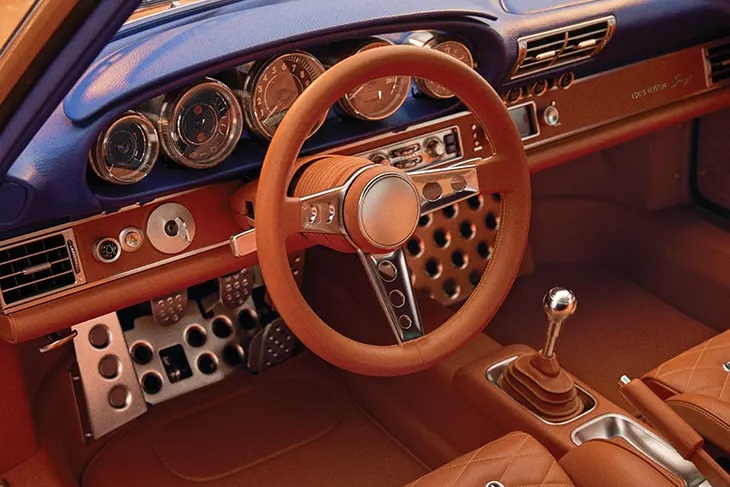
Yellow stitching provides a visual connection between the interior and the exterior colour scheme.
The door handles use edge finishing techniques associated with Louis Vuitton leather goods. The seats incorporate Monogram Flower ventilation details, while the malletage pattern appears in the upholstery and luggage areas.
The result is an interior in which Louis Vuitton references are integrated into the construction rather than applied simply as branding.
The Porsche 911 Reimagined by Singer Classic Turbo
The second automobile takes a different approach.
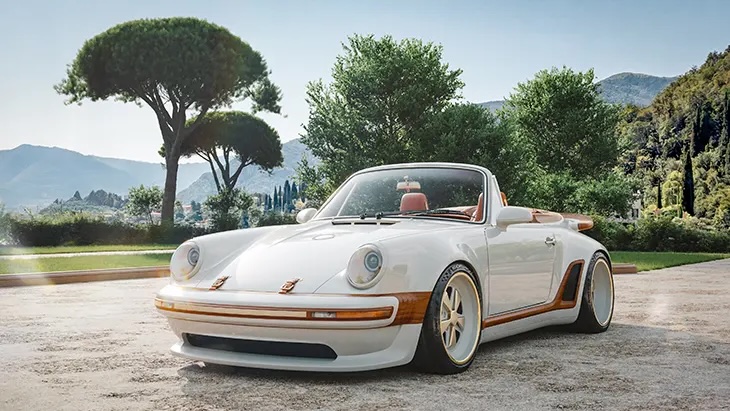
The Porsche 911 developed by Singer Classic Turbo is based on a Type 964 cabriolet and was developed under the creative direction of Nicolas Ghesquière.
Where the Classic emphasizes Louis Vuitton’s travel and luggage heritage, the Classic Turbo explores the relationship between automotive design and the nautical world.
The bodywork is finished in Calcaire Lutétien white, referencing the limestone associated with Paris. Gold details, natural leather and wood create a warmer palette throughout the exterior and interior.
The rear luggage compartment features a wooden deck inspired by classic motorboats. Wood is also incorporated into other parts of the automobile, including the bumpers, front luggage area and rear engine compartment.
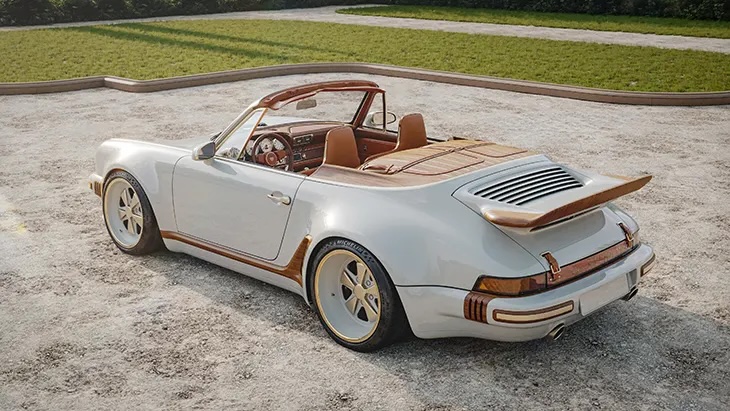
The mechanical specification is equally distinct from the Classic.
The Classic Turbo uses a 3.8 litre twin turbocharged flat six with air to water intercooling. A six speed manual transmission and selectable driving modes send power to the rear wheels. Carbon ceramic brakes complete the chassis specification.
The large rear spoiler references the turbocharged character of the car, while the open body style gives the automobile a different relationship with its surroundings.
Nicolas Ghesquière and the Automotive Design of the Classic Turbo
For Nicolas Ghesquière, the Classic Turbo provided an opportunity to explore a longstanding interest in automobiles through the perspective of fashion and design.
The cabriolet was conceived as an automobile connected to its environment, with the open roof, natural materials and nautical references contributing to that idea.
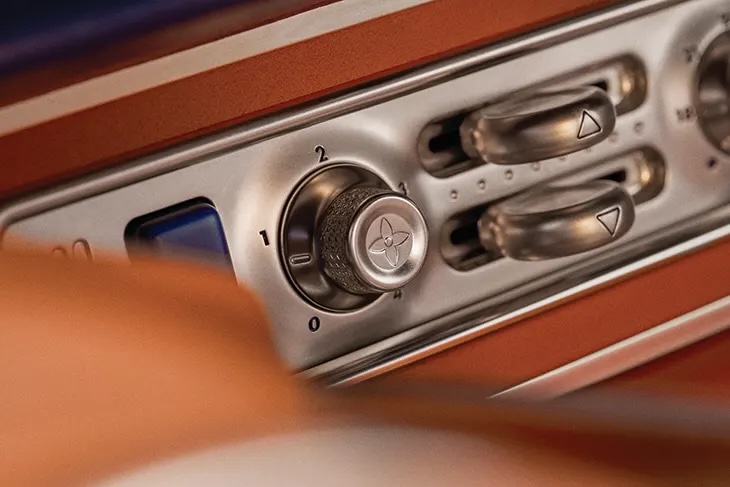
The woodwork is particularly important to the design. Rather than functioning as an ornamental detail, it forms part of the architecture of the luggage areas and connects the car visually with classic motorboats.
The colour palette continues this approach. Calcaire Lutétien white is combined with gold, natural leather and wood, creating a contrast with the saffron and cobalt blue palette of the Classic.
Singer Project Lead Designer, Octave Chany, described the collaboration with Ghesquière as an important part of moving automobiles beyond conventional automotive design and into a broader conversation about proportions, materials and cultural references.
“What makes projects like this one particularly exciting is precisely the opportunity to challenge these constraints and explore new approaches to aesthetics, identity and craftsmanship within the realm of automotive engineering. Projects of this scale and exclusivity allow for a level of attention to detail that is unusual in the automotive world. Every transition between materials, every metallic reflection, every knurled surface, every mechanical interaction and every graphic element has been meticulously considered, often at an almost microscopic level,” explains Octave Chany.
The Classic Turbo Dashboard
The dashboard clock takes a different position in the Classic Turbo.
Rather than being integrated into the primary instrument display, the mechanical Louis Vuitton timepiece is positioned in the center of the console. Its dial is finished to correspond with the exterior bodywork, while gold gauges and a matching ignition key continue the relationship between the exterior and interior.
The dashboard carries the Louis Vuitton signature, while the rear lights incorporate the House’s identity after dark.
A leather detail on the steering wheel references one of Ghesquière’s design signatures. The gearshift trim draws on the silhouette of the Louis Vuitton Noé bag through its natural leather drawstring.
As with the Classic, the functional components are treated as carefully as the decorative elements, with metal controls and finely finished surfaces informed by watchmaking.
Louis Vuitton Luggage Designed Around the Porsche 911
The two automobiles are accompanied by extensive Louis Vuitton luggage and accessories.
For the Classic, the collection includes a helmet bag, Bisten, Keepall and custom front trunk bags. Each piece is intended to work within the physical dimensions and visual language of the automobile.
The Classic Turbo receives its own collection under the creative direction of Nicolas Ghesquière.
The luggage includes an Alma, Express, Noé, Cruiser, Petite Malle and Keepall 45, alongside garment storage and smaller cases designed for the car’s keys and accessories.
The Classic Turbo’s front luggage compartment incorporates a three part trunk system designed specifically for the automobile. The individual cases can be removed and used separately.
The project also includes driving clothing, helmets, footwear, gloves and watches, extending the collaboration from the vehicle into the experience of traveling with it.
Louis Vuitton and the History of the Automobile
The collaboration with Singer continues a relationship between Louis Vuitton and automotive travel that dates to the early development of the motor car.
The House’s first automotive luggage was created during a period when automobiles were becoming increasingly important to long distance travel. Louis Vuitton responded by developing trunks and cases that could be mounted to vehicles and configured around their changing shapes.
In 1909, Pierre and Jean Vuitton designed an automobile using a sports chassis produced by Automobiles Stabilia. The project helped demonstrate the House’s products at a time when transportation, design and luxury were becoming increasingly connected.
Louis Vuitton continued to work with automotive designers and manufacturers throughout the twentieth century, even hosting its own Louis Vuitton Classic Run: Vintage Car Race, which will return this fall.
The relationship between Louis Vuitton and the Automotive industry has therefore existed across several generations of automotive design. This is not the House’s first automotive partnership and collaboration. The Singer project provides a contemporary interpretation of that history that is joyful, and simply put, fun.
Octave Chany further explains, “This collaboration brought together two organizations with a shared belief that true luxury is defined by craftsmanship, authenticity and an uncompromising attention to detail. It has been a privilege for everyone at Singer to be trusted with Louis Vuitton’s remarkable 172 years of tradition and savoir-faire and to incorporate those techniques into our own work”.
Singer and the Porsche 911
Singer Vehicle Design was founded in California in 2009 and is known for restoring and reimagining classic Porsche 911s in collaboration with their owners. The company’s work centers on the Type 964 generation, combining restoration with updated engineering, materials and individualized design. (Singer Vehicle Design official website)
Singer’s approach has established the company within the modern collector car landscape, where original automotive architecture is combined with contemporary engineering and highly individualized specifications.
For the Louis Vuitton project, the Classic was restored in California while the Classic Turbo was crafted in England. (Official Singer press release)
The collaboration brings together two established approaches to craftsmanship.
Singer contributes its knowledge of the Porsche 911, automotive engineering and restoration. Louis Vuitton contributes expertise in leatherwork, watchmaking, trunk making, fashion and travel.
The Project Lead Designer at Singer emphasizes, “The aim was to create a true synthesis between Singer’s architectural and timeless language and the Louis Vuitton culture, characterised by refined materials, travel and expression of style.”
The two cars show how those disciplines can be applied to the same automotive architecture in markedly different ways.
Two Porsche 911s, Two Visions of Travel
The Louis Vuitton and Singer collaboration places two Type 964 Porsche 911s at the center of a broader discussion about automotive design and travel.
The Classic uses saffron, cobalt blue and yellow, natural leather, malletage inspired embossing, metal controls and bespoke travel equipment to connect the automobile with Louis Vuitton’s history of luggage and transportation.
The Classic Turbo takes a more nautical direction through its Calcaire Lutétien white bodywork, wood, gold detailing and open cabin, with Nicolas Ghesquière shaping the creative direction.
Both retain Singer’s focus on the Porsche 911 as a driving machine while introducing materials, craftsmanship and references from outside traditional automotive design.
For Louis Vuitton, the project extends a history of automotive travel into a contemporary setting. For Singer, it provides another interpretation of the Porsche 911 Type 964.
The result is two cars that share an engineering foundation but take distinctly different approaches to materials, design and the idea of travel.
“With the creation of both cars, Louis Vuitton has, for the first time, drawn upon the full breadth of its savoir-faire, bringing together the expertise of every House métier in a unique and exclusive automotive project. Every department at Louis Vuitton has contributed to this unprecedented cross-disciplinary endeavour, from trunk makers and leather goods artisans to the fashion and footwear teams, and even the watchmakers from La Fabrique du Temps Louis Vuitton.” – Jean Arnault.
Specification Overview
Porsche 911 Reimagined by Singer – Classic
- Type 964 coupé chassis
- Lightweight carbonfibre bodywork in saffron
- Cobalt blue and yellow detailing
- Speed activated rear wing
- 4.0 litre naturally aspirated air cooled flat six
- Six speed manual transmission
- Rear wheel drive
- Carbon ceramic braking system
Porsche 911 Reimagined by Singer – Classic Turbo
- Type 964 cabriolet chassis
- Lightweight carbonfibre bodywork in Calcaire Lutétien white
- Whale tail rear wing
- 3.8 litre twin turbocharged flat six
- Air to water intercooling
- Six speed manual transmission
- Selectable driving modes
- Rear wheel drive
- Carbon ceramic braking system
Editorial Note
Singer Vehicle Design is not sponsored, associated, approved, endorsed or affiliated with Porsche Cars North America or Dr. Ing. h.c. F. Porsche AG. Porsche trademarks and model names are referenced for identification purposes only.